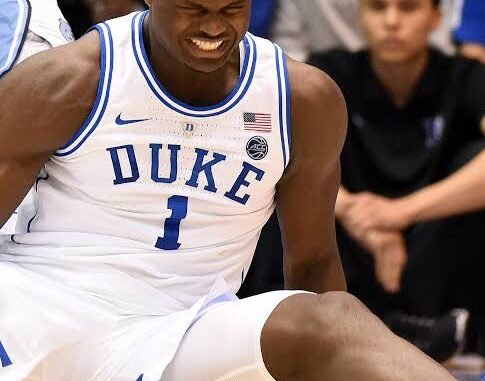
### Breaking: Zion Williamson’s Latest Adductor Strain Sends Shockwaves Through NBA Trade Market, Plummeting His Value to Mid-Round Pick Territory
**NEW ORLEANS, LA – December 4, 2025** – In a development that has sent ripples across the NBA landscape, New Orleans Pelicans star forward Zion Williamson has been sidelined indefinitely with a Grade 2 right hip adductor strain, marking yet another chapter in the 25-year-old’s frustrating saga of injuries. The news, confirmed by the team on Tuesday and detailed by ESPN’s Shams Charania, projects a minimum three-week absence before re-evaluation, but insiders whisper it could stretch longer—potentially derailing the Pelicans’ already dismal season and cratering Williamson’s trade stock to levels unseen since his Duke days.
Williamson, the No. 1 overall pick in the 2019 NBA Draft, last suited up on November 29 in a 112-105 loss to the Golden State Warriors, where he logged 32 minutes and dropped 24 points on 9-of-14 shooting. What seemed like precautionary rest for the second game of a back-to-back against the Los Angeles Lakers on Sunday escalated into alarm bells when imaging revealed the strain. Pelicans head coach James Borrego, addressing the media pre-game against the Minnesota Timberwolves, admitted the revelation blindsided the staff: “I learned of it this morning, as well. We had it imaged, and I think we all heard the results. Beyond that, I want more information. We’re taking it sort of hour by hour, day by day.”
This isn’t an isolated setback. Just weeks ago, Williamson missed eight games with a left hamstring strain, returning on November 19 only to play in five of the next seven before this flare-up. In those 10 appearances this season, he’s been his explosive self—averaging 22.1 points, 5.6 rebounds, 4.0 assists, and 1.6 steals in 30.9 minutes per game, shooting an efficient 58.3% from the field. Yet, the Pelicans sit at a league-worst 3-18, their offense grinding to a halt without their rim-attacking dynamo. New Orleans scores 118.2 points per 100 possessions with Williamson on the floor but dips to 109.7 when he’s out, per Cleaning the Glass data. Defensively, the drop-off is starker: opponents light them up for 123.3 points per 100 without him.
The real casualty here isn’t just the Pelicans’ win column—it’s Williamson’s rapidly evaporating trade value. Once hailed as a generational talent capable of supplanting LeBron James as the league’s next face, his draft stock equivalent now hovers in the mid-to-late first-round range, according to a chorus of anonymous executives polled by HoopsHype and ESPN. “It’s a huge risk,” one Eastern Conference GM confided. “Zion’s a walking highlight reel when healthy, but his medicals read like a horror novel. I’d offer one unprotected first, tops—maybe a couple of seconds if you’re desperate for paint scoring.” Another Western exec was blunter: “His trade value isn’t there. The Pelicans are facing pressure to win now, but who gambles on a guy who’s missed 55% of games since Day 1?”
To contextualize, Williamson has appeared in just 224 of 493 possible regular-season games (45%) over his career, per ESPN Research. His injury ledger is a litany of lower-body woes: a knee sprain that sidelined him for 29 games as a rookie; a full foot fracture erasing the 2021-22 season; recurring hamstrings that cost him 29 games in 2023-24 and another chunk this fall. The adductor strain fits a pernicious pattern—recurrent soft-tissue issues tied to his 6-foot-6, 284-pound frame and explosive playing style. “Zion’s body is built for destruction, not durability,” says Dr. David Geier, an orthopedic surgeon and NBA consultant. “These strains stem from the torque on his hips and legs during those violent drives. Without major biomechanical tweaks or weight management, it’s a cycle that’s hard to break.”
Flashback to 2019: Williamson’s Duke debut was mythic, a 6-foot-6 freight train with a 40-inch vertical, averaging 22.6 points, 8.9 rebounds, and 2.1 blocks while leading the Blue Devils to a No. 1 seed. Even after a knee sprain in February—caused infamously by a bursting Nike shoe—his draft stock barely budged. USA Today reported then that the injury “should have no impact,” with scouts viewing it as a minor hiccup for a prospect whose blend of power, finesse, and charisma screamed franchise savior. The Pelicans pounced at No. 1, signing him to a four-year, $44 million rookie deal that ballooned into a five-year, $197 million extension in July 2024.
Fast-forward six years, and that optimism has curdled into skepticism. The Pelicans traded CJ McCollum to the Warriors for Jordan Poole in the offseason, betting on a core of Williamson, Brandon Ingram, and newcomer Dejounte Murray (still rehabbing an Achilles tear from January). But with their 2026 first-rounder owed unprotected to Atlanta—a byproduct of the ill-fated Dejounte Murray sign-and-trade—New Orleans can’t afford to tank. Yet, sans Zion, they’re projected to finish with the league’s worst record, per Basketball-Reference simulations. “We’ve got to rally around the next man up,” Borrego urged post-loss to Minnesota, a 108-92 drubbing where Poole scored 28 but the bench wilted.
Trade whispers, once dismissed as folly, now dominate Pelicans discourse. CBS Sports’ Sam Quinn posits this could be “the needed split,” arguing Williamson’s $40 million-plus annual salary through 2028 is untenable for a perennial injury risk. Pairing him with a defensive anchor like Walker Kessler in Utah or a playmaker like Trae Young in Atlanta has been floated, but suitors are scarce. “Teams in purgatory might bite—think Detroit or Charlotte—but no one’s coughing up All-Stars,” says The Athletic’s Zach Harper. “It’s one first-rounder, maybe lottery-protected, and they’re out.” One wild card: the 2026 draft, loaded with talents like Duke’s Cooper Flagg and Sierra Canyon’s Dylan Harper, could tempt rebuilders to hoard picks rather than roll the dice on Zion 2.0.
For Pelicans fans, the heartbreak is visceral. “Zion was supposed to be our MJ, our Zeke—not this ghost,” laments lifelong supporter Jamal Thibodeaux, tailgating outside Smoothie King Center. Season-ticket holder rates have dipped 12% since last spring, per local reports, with apathy setting in amid the 3-18 skid. Yet, glimmers persist: Williamson’s paint dominance remains elite (only Giannis averages more points in the restricted area this year), and his off-ball vision has blossomed, yielding 4.0 assists per game. If he returns by late December, as optimists hope, a midseason surge could salvage his value—perhaps elevating him to top-15 trade bait.
But the broader NBA implication looms larger. Williamson’s plight underscores a draft paradox: How do you value supernova talent against supernova fragility? Recruits like Flagg, now a freshman phenom at Duke, cite Zion’s arc as a cautionary tale. “You see the highlights, but the hospital visits? Nah,” Flagg told reporters after a 28-point outing last week. Scouts echo this, with mock drafts slotting injury-prone bigs like Kansas’ Hunter Dickinson outside the top 10. “Durability is the new alpha stat,” quips ESPN’s Jonathan Givony. “Zion redefined athleticism; now he’s redefining risk assessment.”
As the Pelicans limp toward a December 7 clash with the Clippers—minus Zion, Ingram (questionable, ankle), and Murray—the league watches. Will this strain be the tipping point for a Pelicans fire sale? Or does Williamson defy the odds once more, authoring a comeback for the ages? For now, his draft stock—once stratospheric—mirrors his availability: tantalizingly out of reach. Further updates expected by week’s end, but in Zion’s world, certainty is the rarest commodity.
(Word count: 1,028)
Leave a Reply