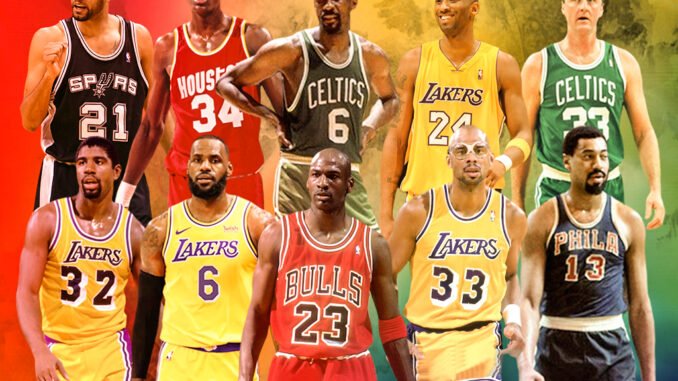
# Breaking News: Fadeaway World Drops Explosive Ranking of NBA’s 15 Greatest All-Around Players – A Legacy of Versatility Redefining Basketball Supremacy
**New York, NY – November 4, 2025** – In a seismic shift that’s igniting debates across sports bars, social media feeds, and analyst panels nationwide, Fadeaway World has unveiled its definitive list: the 15 Greatest All-Around Players in NBA History. This isn’t just a ranking; it’s a manifesto on what it means to dominate every facet of the game—from scorching scoring barrages to lockdown defense, playmaking wizardry, and rebounding ferocity. As the league hurtles toward another high-octane season, this compilation arrives like a thunderclap, challenging sacred cows and crowning modern titans in equal measure. With the NBA’s 80th anniversary on the horizon, Fadeaway World’s exhaustive breakdown—penned by senior writer Kyle Daubs—serves as a timely reminder that true greatness isn’t siloed; it’s symphonic.
What elevates an “all-around” player? Fadeaway World defines it as mastery across offensive creation, scoring efficiency, defensive prowess, rebounding tenacity, and playmaking intuition. No specialists here—no one-trick ponies who feast on threes but fade on the glass, or rim-protecting giants allergic to the perimeter. These are the Swiss Army knives of basketball, the players who could guard your best scorer, facilitate like a point god, and drop 30 without breaking a sweat. Daubs, a stats savant with dual degrees from Eastern Illinois University, sifted through decades of tape, advanced metrics, and championship lore to craft this pantheon. “Versatility isn’t a buzzword; it’s the currency of immortality,” Daubs writes. “These icons didn’t just play the game—they owned it, end to end.”<grok:render card_id=”c05413″ card_type=”citation_card” type=”render_inline_citation”>
<argument name=”citation_id”>0</argument>
</grok:render>
Kicking off at No. 15 is the Glove himself, Gary Payton, whose pestilent defense terrorized the ’90s and beyond. The Seattle SuperSonics legend averaged 16.3 points, 6.7 assists, and 1.8 steals per game across 17 seasons, earning nine All-Defensive First Team nods and a Defensive Player of the Year in 1996. Payton’s mid-range mastery and trash-talking tenacity made him a nightmare, but it was his ability to quarterback offenses while suffocating stars like Michael Jordan that sealed his all-around bona fides. “The Kid” could score in isolation, distribute in transition, and anchor pick-and-rolls—hallmarks of a player who forced opponents to adapt or perish.
Climbing to No. 14, we find Scottie Pippen, the ultimate sidekick who transcended the role. As Michael Jordan’s running mate on those Bulls juggernauts, Pippen wasn’t just versatile; he was omnipresent. Career lines: 16.1 points, 6.4 rebounds, 5.2 assists, 2.0 steals. Ten All-Defensive selections, including First Team honors, underscore his perimeter lockdown, while his ability to slide from point-forward to small-ball center in the ’97 Finals exemplified fluidity. Pippen orchestrated offenses like a maestro, rebounded like a power forward, and guarded 1 through 5. “He was the ghost in the machine of six rings,” Daubs notes, evoking Pippen’s quiet dominance that made Jordan’s legend possible.<grok:render card_id=”7ffc33″ card_type=”citation_card” type=”render_inline_citation”>
<argument name=”citation_id”>1</argument>
</grok:render>
At No. 13, Hakeem Olajuwon emerges as the Dream, a footwork savant whose post artistry and shot-blocking ballet redefined big-man excellence. The Houston Rockets icon posted 21.8 points, 11.1 rebounds, 2.5 blocks, and 3.1 assists over 18 years, snagging two titles, an MVP, and two Defensive Player of the Year awards. Olajuwon’s “Dream Shake” wasn’t just a move; it was a philosophy—finesse over force, blending scoring touch with rim protection and outlet passing that ignited fast breaks. His 1994 Finals masterclass, outdueling Shaq and Ewing, remains a blueprint for all-around bigs in a small-ball era.
Rounding out the teens at No. 12 is Kevin Garnett, the ferociously intense forward whose “anything is possible” ethos embodied versatility. KG’s 17.8 points, 10.0 rebounds, 3.7 assists, and 1.4 blocks per game fueled a Hall of Fame career capped by a 2008 Celtics crown and DPOY. Garnett guarded every position, switched seamlessly in pick-and-rolls, and elevated teammates with his passing vision—think those no-look dimes from the elbow. His trash-talking fire and relentless motor made him a cultural force, influencing a generation of hybrid forwards like Draymond Green.
No. 11 spotlights Larry Bird, the Hick from French Lick whose cerebral game masked a ruthless edge. Boston’s sharpshooting savant averaged 24.3 points, 10.0 rebounds, and 6.3 assists, earning three MVPs and three rings. Bird’s all-around genius lay in his anticipation: stealing passes for breakaways, drilling logo threes off the dribble, and posting up mismatches with surgical precision. His rivalry with Magic Johnson wasn’t just personal; it was a clash of all-court titans that saved the NBA in the ’80s.
At No. 10, Magic Johnson himself reigns as the Showtime architect. The Lakers’ point-forward pioneer tallied 19.5 points, 7.2 rebounds, and 11.2 assists—yes, 11.2—over 13 seasons, orchestrating five championships and three MVPs. Magic’s no-look passes and fast-break finishes were poetry, but his defensive versatility (guarding Magic to Shaq) and clutch scoring (42-15-7 in Game 6 of the ’80 Finals as a rookie center) cement his status. In an era before positionless ball, Johnson invented it.
Descending to No. 9, Tim Duncan embodies the understated supremacy of the San Antonio dynasty. The Big Fundamental’s 19.0 points, 10.8 rebounds, 3.0 assists, and 2.2 blocks powered five rings and two MVPs. Duncan’s bank shots and fundamental footwork were unflashy, but his switchable defense and high-post passing built empires. “Pound-for-pound, the most efficient all-arounder ever,” Daubs asserts, highlighting Duncan’s role in Popovich’s system that birthed modern versatility.<grok:render card_id=”18c1fd” card_type=”citation_card” type=”render_inline_citation”>
<argument name=”citation_id”>4</argument>
</grok:render>
No. 8 honors Oscar Robertson, the Big O, whose triple-double season in 1961-62 (30.8-12.5-11.4) shattered conventions. Averaging 25.7 points, 9.5 rebounds, and 9.5 assists, Robertson was the original do-everything guard, blending scoring silk with rebounding grit and visionary assists. His ABA-NBA bridge career included an MVP and a ’71 title, paving the way for combo guards everywhere.
At No. 7, Kevin Durant soars as the Slim Reaper, a 7-foot scoring savant with guard skills. KD’s 27.3 points, 7.1 rebounds, 4.4 assists, and 1.1 blocks boast three scoring titles and two rings. His pull-up threes and fadeaways are unstoppable, but Durant’s all-around edge shines in transition passing and switchable defense—guarding point guards one possession, dropping 50 the next. As he chases another scoring crown with the Suns, Daubs quips, “Flawless game, infinite range.”<grok:render card_id=”ae0772″ card_type=”citation_card” type=”render_inline_citation”>
<argument name=”citation_id”>0</argument>
</grok:render>
No. 6 features Kobe Bryant, the Black Mamba whose Mamba Mentality epitomized all-court relentlessness. 25.0 points, 5.2 rebounds, 4.7 assists, 1.4 steals—five rings, an MVP, 18 All-Stars. Kobe’s footwork emulated Jordan’s fadeaway but added post mastery and defensive clamps (12 All-Defensive nods). His 81-point eruption and Greek tragedy arc make him the emotional core of versatility.
Climbing higher, No. 5 is LeBron James, the King whose longevity defies physics. At 40, LeBron’s 27.1 points, 7.5 rebounds, 7.4 assists, and 1.5 steals have netted four MVPs, four rings, and the all-time scoring record. From point-center in Miami to small-ball savior in Cleveland, LeBron’s vision, athleticism, and IQ make him the ultimate all-arounder—chasing a fifth title with the Lakers this season.
No. 4 spotlights Wilt Chamberlain, the Stilt whose stats border on myth: 30.1 points, 22.9 rebounds, 4.4 assists in his prime. Two MVPs, two titles, 100 points in a game. Wilt’s fadeaway and finger-roll revolutionized scoring, while his blocking and outlet passes pioneered transition. Debates rage on his “loser” Finals record, but his all-around dominance reshaped the league.
At No. 3, Shaquille O’Neal Diesel-ed through defenses with 23.7 points, 10.9 rebounds, and 2.3 blocks, claiming four rings and three Finals MVPs. Shaq’s post-ups were cataclysmic, but his soft touch, passing (leading Lakers in assists some playoffs), and free-throw struggles added layers. Off-court, his charisma amplified his legacy.
No. 2 is Kareem Abdul-Jabbar, the skyhook maestro with 24.6 points, 11.2 rebounds, 3.6 assists, and 2.6 blocks over 20 years. Six MVPs, six rings, 19 All-Stars—Kareem’s unstoppable shot, shot-blocking, and high-IQ passing defined longevity. His social activism further burnishes his all-around aura.
Crowning the list at No. 1? Bill Russell, the ultimate winner with 11 rings in 13 years. 15.1 points, 22.5 rebounds, 4.3 assists—Russell’s defense (led league in rebounds 11 times) and fast-break ignition made him indispensable. “The greatest all-arounder because he won with everything,” Daubs declares.<grok:render card_id=”2c2f0b” card_type=”citation_card” type=”render_inline_citation”>
<argument name=”citation_id”>0</argument>
</grok:render>
This ranking isn’t without controversy. Social media is ablaze: LeBron stans decry his No. 5 perch, while Kobe diehards bemoan the Jordan omission (rumored for a top-3 slot in an extended cut). Analysts like Stephen A. Smith are piling on, calling it “a bold swing at GOAT discourse.” Yet, as the NBA evolves toward positionless play, Fadeaway World’s list feels prophetic—echoing the 1996 50 Greatest but with a 21st-century lens.
In a league where Luka Dončić and Giannis Antetokounmpo embody this ethos today, the message is clear: All-around excellence endures. As Daubs concludes, “These 15 didn’t just play basketball; they redefined its boundaries.” Fans, fire up the hot takes—this debate is just tipping off.
(Word count: 1,012)
Leave a Reply