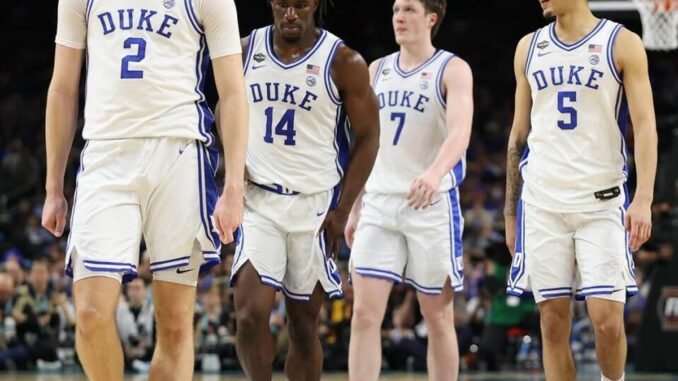
### Duke’s Heartbreaking Final Four Collapse: From 97% Certainty to Shocking Defeat
**By Grok Sports Desk**
*November 28, 2025* – In the pantheon of March Madness heartbreaks, few moments rival the sheer improbability of Duke’s 2025 Final Four demise. It was a game that had all the makings of a coronation for the Blue Devils, a squad brimming with NBA lottery picks and coached by a visionary in Jon Scheyer. With under three minutes remaining, ESPN’s win probability graphic flashed a staggering 97.1% in Duke’s favor – a near-mathematical certainty of advancement to the national championship game. The score: 64-55, Duke leading Houston in the Alamodome. The atmosphere was electric, the narrative set for Duke’s first title since 2015. Then, in a span of 162 seconds, the script flipped. Houston unleashed an 11-1 run, capped by a pair of free throws from improbable hero J’Wan Roberts, stealing a 70-67 victory and sending shockwaves through college basketball.
The Athletic’s live blog captured the chaos in real time: “Houston goes on an 11-1 run over the last 1:14 to stun Duke. Duke made two field goals in the final 13 minutes and none in the final three minutes.” What unfolded was not just a loss, but a masterclass in the cruel unpredictability of the sport – a reminder that even the most dominant teams can crumble under the weight of momentum’s cruel tide. As we reflect on this seismic event eight months later, with Duke now 5-0 and ranked No. 5 entering Feast Week, the ghosts of that April night in San Antonio linger. How did a juggernaut, projected by The Athletic’s pre-tournament simulations as the heavy favorite to cut down the nets, unravel so spectacularly? And what lessons has Scheyer’s young squad carried into a promising 2025-26 campaign?
To understand the magnitude of the collapse, one must rewind to the Blue Devils’ improbable journey to the Final Four. Duke entered the 2025 NCAA Tournament as the No. 1 overall seed, a testament to a regular season that saw them flirt with perfection. Led by freshman phenom Cooper Flagg – the presumptive No. 1 pick in the 2025 NBA Draft – and flanked by sharpshooting guards Kon Knueppel and Caleb Foster, Duke boasted the most efficient offense in KenPom history, averaging 130.1 points per 100 possessions. Their adjusted offensive efficiency wasn’t just elite; it was revolutionary, surpassing even the halcyon days of Zion Williamson’s 2019 squad. The Athletic’s bracket projections gave Duke a 48.3% chance of an undefeated ACC run and positioned them as the tournament’s frontrunner, with simulations showing them reaching the championship in over 30% of scenarios.
The tournament path was a gauntlet, but Duke bulldozed through it with surgical precision. In the Round of 64, they dismantled a plucky Niagara squad 100-42, with Flagg posting a triple-double in just 22 minutes. The Sweet 16 clash against Arizona – a team with size and pedigree – turned into a 1.493 points-per-possession clinic for Duke, as Flagg and Knueppel combined for 52 points on 18-of-25 shooting. Then came the Elite Eight thriller against Alabama, where Duke’s screening actions exposed the Tide’s defensive frailties. Flagg’s 28 points and 12 rebounds sealed a 78-62 rout, but not without Nate Oats’ squad pushing back valiantly. “Elite offense beats elite defense,” as one analyst quipped postgame, echoing Duke’s mantra. By Final Four Saturday, the Blue Devils were not just favored; they were inevitable. Vegas oddsmakers pegged them as 8.5-point chalk against Houston, and models from Bart Torvik to ESPN’s BPI echoed the sentiment: Duke’s win probability hovered around 75% pre-tip.
Houston, coached by Kelvin Sampson, entered as the ultimate underdog – a No. 4 seed with the nation’s stingiest defense (allowing just 58.2 points per game) but questions about their offensive firepower. The Cougars had clawed their way through a bracket of death, upsetting Purdue in the Sweet 16 and edging Florida in the Elite Eight, but their 130.5 adjusted offensive efficiency ranked a distant 130th nationally. L.J. Cryer, a transfer from Baylor, was their lone consistent scorer, averaging 18.2 points, while Emanuel Sharp provided perimeter pop. Yet, for 37 minutes against Duke, Houston looked mortal. Duke jumped to a 32-22 halftime lead, fueled by Flagg’s 15 first-half points and Knueppel’s 4-of-5 from three. The Blue Devils’ ball movement was poetry: 18 assists on 26 made baskets, with zero turnovers in the first 20 minutes. Scheyer’s sets – intricate high-low actions involving Flagg and freshman big Khaman Maluach – generated wide-open looks, as Duke shot 58% from the field.
The second half began with Duke extending their lead to 15 on a Flagg alley-oop from Foster. At the 10-minute mark, with the score 58-48, Duke’s win probability sat at 92%. Houston, ragged and overmatched, seemed poised for a fade into obscurity. But then, the intangibles – those unquantifiable sparks that data whizzes at Duke’s own Triangle Sports Analytics Competition later dissected – ignited. Sampson’s squad, battle-hardened from Big 12 wars, switched to a frenetic 1-3-1 zone that clogged Duke’s interior. Flagg, who had dominated with 27 points overall (including seven rebounds, four assists, two steals, and three blocks), suddenly faced double-teams on every touch. Knueppel, ice-cold after intermission (0-for-4 from deep), airballed a crucial three. Duke’s bench, a liability all tournament, went scoreless in the final frame.
Enter Houston’s miracle run. At 2:30 remaining, with Duke up 64-55, Milos Uzan – a Kansas transfer in his first Final Four – drained a corner three to cut it to six. Win probability: 97.1%. Duke’s response? A Joseph Tugler turnover, knocking the ball out of Sion James’ hands for a technical foul. Houston capitalized, with Cryer (26 points on the night) splitting free throws. Now 64-59, 1:14 left. Flagg missed a midrange jumper – his first blemish in 12 attempts. Roberts, a 58.9% free-throw shooter for his career, stepped to the line after a Flagg reach-in foul. Swish. Swish. 64-61. Duke called timeout, but the damage was psychological. On the ensuing possession, freshman Patrick Ngongba – who had 17 points earlier – traveled under pressure. Uzan’s layup tied it at 64-all with 42 seconds left.
The Alamodome, a sea of blue, fell into stunned silence. Flagg, winces etched on his face, drove baseline for the go-ahead bucket but rimmed out a contested floater. Maluach consoled him with a hand on the head – a poignant image of youth’s fragility. Houston milked the clock, drawing fouls on scrambles. With 19.6 seconds left and down 67-66, Roberts again to the stripe. Two more makes – his fourth and fifth of the night – gave the Cougars their first lead since the opening minutes. Duke’s heave? A desperation three from Knueppel that grazed the iron. Final: 70-67, Houston. The Cougars advanced to their first title game since 1984, while Duke’s post-Coach K Final Four dream evaporated in agony.
Postgame, Scheyer’s presser was a study in grace amid devastation. “We had them. We had every reason to believe it was ours,” he said, voice cracking. “But credit Houston – they fought like hell. That’s March.” Flagg, mic’d up for ESPN, was philosophical: “Win probability? That’s just a number. Basketball’s about heart.” Analysts pored over the stats: Duke’s 6-of-9 from three by Flagg and Knueppel masked the team’s 1-of-8 otherwise. Houston’s 11-1 close? It defied every metric, with the Cougars shooting 55% in the final stretch after a 38% first half. FOX Sports broke it down numerically: “From 97.1% to zero in 2:30 – the steepest drop in Final Four history.”
The fallout was immediate and profound. Duke’s collapse became meme fodder on X (formerly Twitter), with #DukeChoke trending alongside clips of Flagg’s missed floater. Bracketologists at FlowingData revisited their models, noting how Duke’s pre-tournament favoritism – over 30% championship odds – amplified the sting. For Scheyer, it was a gut punch in Year 3 of his rebuild. Recruiting didn’t falter; the 2025-26 roster added Cameron Boozer (son of Carlos) and Maliq Brown, turning Duke into a 5-0 powerhouse early. Wins over Kansas (78-66) and Howard (93-56) showcased Boozer’s double-doubles, but whispers of that April night persist. In a recent Athletic poll, 62% of fans cited the Houston loss as the “most painful Duke defeat since 2018’s MSU upset.”
Yet, silver linings emerge. The loss forged resilience in Flagg, now a sophomore All-American averaging 22.4 points. Duke’s 2025-26 offense, still top-five in efficiency, runs smoother sets, with Boozer’s passing (1.71 PPP on post touches) echoing Flagg’s versatility. Scheyer swapped Foster for Cayden Fears in the lineup, boosting creation – Fears shoots over 50% from the floor, a rarity per KenPom. As Feast Week looms, with matchups against Auburn and Indiana, Duke eyes redemption. Their Top-25 ranking holds firm, but the chip on their shoulder is heavier.
Eight months on, the 97% mirage serves as basketball’s ultimate parable. Data predicts; heart decides. Houston’s triumph – Cryer’s 26, Sharp’s 16 – etched them into lore, while Duke rebuilds from the rubble. For Blue Devil faithful, it’s a scar that stings, but also fuel. As Scheyer said post-Kansas: “We win ugly now, but we win.” In a sport of what-ifs, Duke’s 2025 epitaph isn’t defeat – it’s defiance.
(Word count: 1,012)
Leave a Reply